The WordPress.com stats helper monkeys prepared a 2011 annual report for this blog.

Here’s an excerpt:

The concert hall at the Syndey Opera House holds 2,700 people. This blog was viewed about 10,000 times in 2011. If it were a concert at Sydney Opera House, it would take about 4 sold-out performances for that many people to see it.

Click here to see the complete report.

VM Backup – Backing up Virtual Machines with Windows Server 2008 R2 & Hyper-V

Overview

Virtual machines are basically made of files. They contain configuration files, virtual hard disks, snapshot files and saved state files. While running computers are virtual machines can benefit from virtualization, a lot of thought needs to be taken in order to protect the contents of the virtual machines and the VMs themselves, so that if something goes wrong, you can perform a pre-defined list of steps to successfully restore the VMs to a functional and running state.

Note: To install Windows Server Backup, log on to the computer by using the local Administrator account or another account with Administrator privileges. To perform backups or recoveries by using Windows Server Backup, you must be a member of the Administrators or Backup Operators groups.

Performing the backup

To perform the actual VM backup follow these steps:

1. Open Windows Server Backup from the Administrative Tools folder. In the Actions pane, click “Backup Once” (you can, of course, create a schedule for this backup).


2. In the “Backup Options” page, select “Different Options” and click Next.

3. In the “Select Backup Configuration” page, select “Custom” and click Next.

4. In the “Select Items for Backup” page, click “Add Items“.

5. In the “Select Items” window, click to select the volumes where the VM configuration files and VM hard disks are located. Also note that while it may look possible to select individual folders, do NOT select individual folders. Only select the entire volume. Failing to select the right volumes will result in a failure for the backup procedure and even if it will seem to you that all items were backed up, in fact you will not be able to restore your VMs. Click Ok.

6. Back in the “Select Items for Backup” page, click “Advanced Settings“.

7. In the “Advanced Settings” window, click to select “VSS Full Backup” and click Ok.

8. Back in the “Select Items for Backup” page, click Ok.

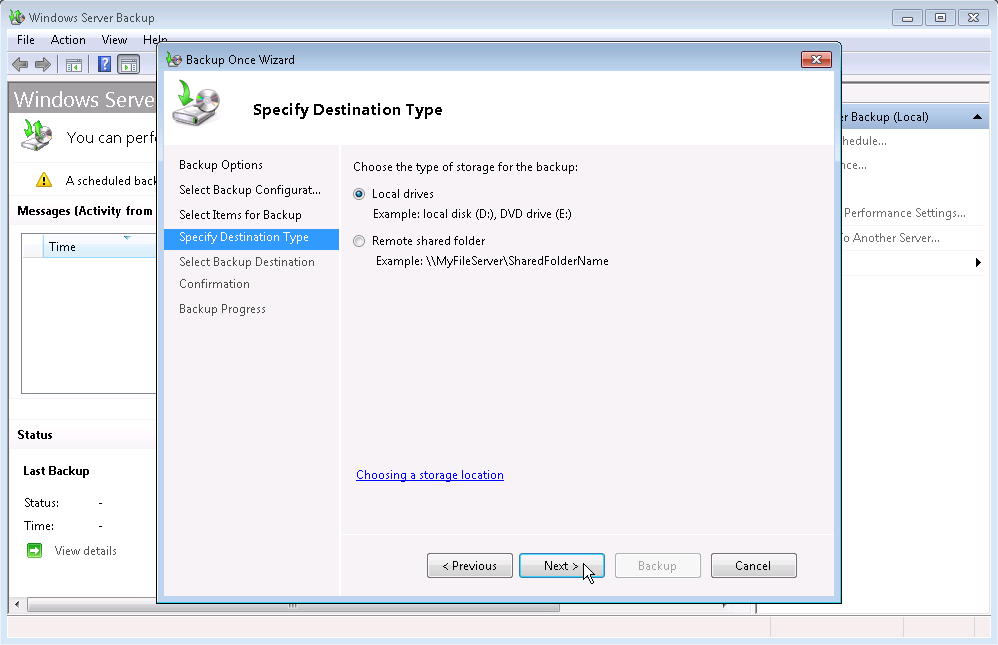
9. In the “Specify Destination Type” page, select the destination for the backup. I chose Local Drives, but you can also perform the backup on remote shares. Click Next.

10. In the “Select Backup Destination” page, use the drop-down list to select your destination. If you plan to backup on an external USB drive, make sure the computer recognizes it before you get to this spot. Also make sure that the destination volume contains enough free disk space for the backup to be place in. Remember that volume level backup are ALWAYS full, therefore if you’ve got 500 GB worth of VMs in one volume, you’ll need to have as much space as that (and preferably more) on your destination volume. Click Ok.

11. In the “Confirmation” page click Backup and let the backup procedure begin.

12. If you immediately switch to the Hyper-V management console, you’ll see that the VMs are being snapshotted. This is not equivalent to taking a Hyper-V snapshot, which in fact is not really a true snapshot and has nothing in relation to VSS snapshots. Because the VSS writer was registered, and because the Integration Services (Components) are installed and enabled on the VMs, they will be successfully backed up without being paused, saved or turned off. In addition, the ICs will inform the VMs that a backup procedure is taking place on the parent partition, so any VSS-aware application that is running inside the VM will also be triggered (which is very important for applications such as SQL, Exchange and so on).

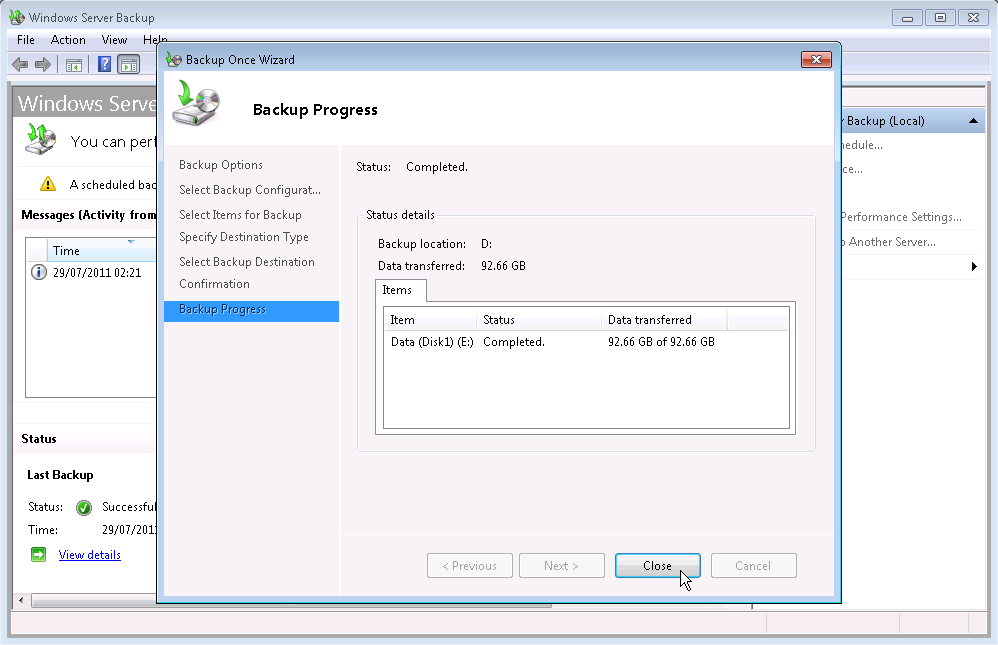
13. Windows Server Backup begins to write the file(s) to disk.

14. When finished, click Close.

Summary

Backing up virtual machines can be a little different than backing up a traditional system.  Because a virtual machine is nothing more than a collection of files, it is important to be especially mindful of the backup process. One oversight along the way can mean a failed VM backup.  Hopefully this article has prepared you to backup your Virtual Machines with Hyper-V using Windows Server Backup.


Source: Petri

You’ve probably noticed that Windows Server 2003 has a new feature that requests a shutdown reason each time you restart the server. This feature is called the Shutdown Event Tracker.

If you are working in a test environment, you might choose to disable this feature to avoid the hassle of typing in a reason each time you restart. To disable this feature, you can perform the following steps:

1. Click Start, click Run, and type gpedit.msc and press Enter.

2. Expand the Computer Configuration and then Administrative Templates objects. Click on the System object. In the right-hand pane you’ll see several settings appear.

3. Locate and double-click that Display Shutdown Event Tracker setting. The Display Shutdown Event Tracker Properties dialog box opens.

4. Click the Disabled radio button to disable the Shutdown Event Tracker. Click OK.


Close the Group Policy Editor console. Now when you shut down this server, you won’t be asked to enter a reason.

To add a snap-in to an existing MMC, complete the following steps:

1. Click Start, point to All Programs, point to Administrative Tools, and then click the name of the custom MMC.

2. On the File menu, click Add/Remove Snap-In.

3. In the Standalone tab in the Add/Remove Snap-In dialog box, click Add.

4. In the Add Standalone Snap-In dialog box, select the snap-in you want to add to the existing MMC and click Add.

5. Enter additional details for the snap-in as described in the previous procedure.

6. When you are finished adding snap-ins, click Close in the Add Standalone Snap-In dialog box. The snap-ins you have added appear in the list in the Add/Remove Snap-In dialog box.

7. In the Add/Remove Snap-In dialog box, click OK. MMC displays the snap-ins you have added in the console tree below Console Root.

To remove a snap-in from an existing MMC, complete the following steps:

1. Click Start, point to All Programs, point to Administrative Tools, then click the name of the custom MMC.

2. On the File menu, click Add/Remove Snap-In.

3. In the Standalone tab in the Add/Remove Snap-In dialog box, select the snap-in you want to delete and click Remove. Then click OK. The snap-in is removed from the console.

To add or remove an extension to a snap-in on an existing MMC, complete the following steps:

1. Click Start, point to All Programs, point to Administrative Tools, and then click the name of the custom MMC.

2. On the File menu, click Add/Remove Snap-In.

3. In the Standalone tab in the Add/Remove Snap-In dialog box, select the snap-in for which you want to

add or remove an extension. Then click the Extensions tab.

4. In the Extensions tab, indicate the extension(s) you want to add or delete, as follows:

❑ To add an extension, click the desired extension.

❑ To remove an extension, clear the Add All Extensions check box and then in the Available Extensions box, clear the check box for the desired extension.

5. Click OK.

6. Expand the snap-in to confirm that the desired extension has been added or removed.


1. To restore the system state on a domain controller, first start the computer in Directory Services Restore Mode. To do so, restart the computer and press the F8 key when you see the Boot menu.

2. Choose Directory Services Restore Mode.

3. Choose the Windows 2000 installation you are going to recover, and then press ENTER.

4. At the logon prompt, supply the Directory Services Restore mode credentials you supplied during the Dcpromo.exe process.

5. Click OK to acknowledge that you are using Safe mode.

6. Click Start, point to Programs, point to Accessories, point to System Tools, and then click Backup.

7. Click the Restore tab.

8. Click the appropriate backup media and the system state to restore.

NOTE: During the restore operation, the Winnt\Sysvol folder must also be selected to be restored to have a working sysvol after the recovery process. Be sure that the advanced option to restore “junction points and data” is also selected prior to the restore. This ensures that sysvol junction points are re-created.

9. In the Restore Files to box, click Original Location.

NOTE: When you choose to restore a file to an alternative location or to a single file, not all system state data is restored. These options are used mostly for boot files or registry keys.

10. Click Start Restore.

11. After the restore process is finished, restart the computer.

Flexible Single Master Operation Roles

1. Domain Naming Master —ForestWide Roles

2. Schema Master —ForestWide Roles

3. RID Master (Relative ID Master) — Domain Wide Roles

4. PDC Emulator — Domain Wide Roles

5. Infrastructure Master — Domain Wide Roles


Relative ID (RID) Master: — it assigns RID and SID to the newly created object like Users and computers. If RID master is down (u can create security objects up to RID pools are available in DCs) else u can’t create any object one its down. The RID master is responsible for processing RID pool requests from all domain controllers in a particular domain. When a DC creates a security principal object such as a user or group, it attaches a unique Security ID (SID) to the object.

PDC emulator: It works as a PDC to any NT Bdcs in your environment

It works as Time Server (to maintain same time in your network)

It works to change the passwords, lockout etc. The PDC emulator is necessary to synchronize time in an enterprise. Windows 2000/2003 includes the W32Time (Windows Time) time service that is required by the Kerberos authentication protocol. All Windows 2000/2003-based computers within an enterprise use a common time

  • Authentication failures that occur at a given DC in a domain because of an incorrect password are forwarded to the PDC emulator before a bad password failure message is reported to the user.
  • Account lockout is processed on the PDC emulator.
  • Editing or creation of Group Policy Objects (GPO) is always done from the GPO copy found in the PDC Emulator’s SYSVOL share, unless configured not to do so by the administrator.

At any one time, there can be only one domain controller acting as the PDC emulator master in each domain in the forest.


Infrastructure Master: This works when we are renaming any group member ship object this role takes care. When an object in one domain is referenced by another object in another domain, it represents the reference by the GUID, the SID (for references to security principals), and the DN of the object being referenced. The infrastructure FSMO role holder is the DC responsible for updating an object’s SID and distinguished name in a cross-domain object reference. At any one time, there can be only one domain controller acting as the infrastructure master in each domain.

Domain Naming Master: Adding / changing / deleting any Domain in a forest it takes care,. This DC is the only one that can add or remove a domain from the directory. There can be only one domain naming master in the whole forest.

Schema Master: It maintains structure of the Active Directory in a forest. The schema master domain controller controls all updates and modifications to the schema. Once the Schema update is complete, it is replicated from the schema master to all other DCs in the directory. There can be only one schema master in the whole forest.

Keys serve as containers in the registry. Keys can contain other keys (subkeys). Keys can also contain value entries, or simply, values. These are the ‘‘substance’’ of the registry. Values comprise three parts: name, data type, and value. The name identifies the setting. The data type describes the item’s data format. The value is the actual data. The following list summarizes data types currently defined and used by the system:


  • Binary Value: This data type stores the data in raw binary format, one value per entry. The Registry Editor displays this data type using hexadecimal format.
  • DWORD value: This data type stores data as a four-byte number (32-bit), one value per entry. The Registry Editor can display this data type in binary, hexadecimal, or decimal formats.
  • QWORD value: This data type stores data as a 64-bit number, one value per entry. The Registry Editor can display this data type in binary, hexadecimal, or decimal formats.
  • Expandable string value: This is a variable-length string that includes variables that are expanded when the data is read by a program, service, and so on. The variables are represented by % signs; an example is the use of the %systemroot% variable to identify the root location of the Windows Server 2008 folder, such as a path entry to a file stored in systemroot\System32. One value is allowed per entry.
  • Multi-String value: This data type stores multiple string values in a single entry. String values within an item are separated by spaces, commas, or other such delimiters.
  • String value: This data type stores a single, fixed-length string, and is the most common data type used in the registry.

A backup is an exact copy of a file (including documentation) that is kept on a storage medium (usually in a compressed state) in a safe place (usually at a remote location) for use in the event that the working copy is destroyed. Notice that we placed emphasis on “including documentation”, because every media holding backups must include a history or documentation of the files on the media. This is usually in the form of labels and identification data on the media itself, on the outside casing, and in spreadsheets, hard catalogs, or data ledgers in some form or another. Without history data, restore media cannot locate your files, and the backup is useless. This is why you can prepare a tape for overwriting by merely formatting the label so that the magnetic head thinks the media is blank.


Various types of backups are possible, depending on what you back up and how often you back it up, as the following list describes:

  • Archived backup: A backup that documents (in header files, labels, and backup records) the state of the archive bit at the time of copy. The state (on-off) of the bit indicates to the backup software that the file has been changed since the last backup. When Windows Server 2008 Backup does an archived backup, it sets the archive bit accordingly.


  • Copy backup: An ad hoc “raw” copy that ignores the archive bit state. It does not set the archive bit after the copy. A copy backup is useful for quick copies between DR processes and rotations or to pull an “annual” during the monthly rotation


  • Daily backup: This does not form part of any rotation scheme. It is just a backup of files that have been changed on the day of the backup. We question the usefulness of the daily backup in Backup, because mission-critical DR practice dictates the deployment of a manual or automated rotation scheme. In addition, Backup does not offer a summary or history of the files that have changed during the day


  • Normal backup: A complete backup of all files (that can be backed up), period. The term normal is more a Windows Server 2008 term, because this backup is more commonly called a full backup in DR circles. The full backup copies all files and then sets the archive bit to indicate (to Backup) that the files have been backed up. You would do a full backup at the start of any backup scheme. You would also need to do a full backup after making changes to any scheme. A full backup, and documentation or history drawn from it, is the only means of performing later incremental backups. Otherwise, the system would not know what has or has not changed since the last backup.


  • Incremental backup: A backup of all files that have changed since the last full or incremental backup. The backup software sets the archive bit, which thereby denotes that the files have been backed up. Under a rotation scheme, a full restore would require you to have all the incremental media used in the media pool, all the way back to the first media, which contains the full backup. You would then have the media containing all the files that have changed (and versions thereof) at the time of the last backup.


  • Differential backup: This works exactly like the incremental, except that it does not do anything to the archive bit. In other words, it does not mark the files as having been backed up. When the system comes around to do a differential backup, it compares the files to be backed up with the original catalog. Differential backups are best done on a weekly basis, along with a full, or normal, backup, to keep differentials comparing against recently backed up files.

.NET Framework 3.0


Provides .NET Framework 3.0 APIs for application development. Additional sub features include .NET Framework 3.0 Features, XPS Viewer, and Windows Communication Foundation (WCF) Activation Components.


Bit Locker Drive Encryption


Provides hardware-based security to protect data through full-volume encryption that prevents disk tampering while the operating system is offline. Computers that have Trusted Platform Module (TPM) can use BitLocker Drive Encryption in Startup Key or TPM-only mode. Both modes provide early integrity validation.


Background Intelligent Transfer Service (BITS) Server Extensions


Provides intelligent background transfers. When this feature is installed, the server can act as a BITS server that can receive file uploads by clients. This feature isn’t necessary for downloads to clients using BITS.


Connection Manager Administration Kit (CMAK)


Provides functionality for generating Connection Manager Profiles.


Desktop Experience


Provides additional Windows Vista desktop functionality on the server. Windows Vista features added include Windows Media Player, desktop themes, and Windows Photo Gallery. Although these features allow a server to be used like a desktop computer, they can reduce the server’s overall performance.


Failover Clustering


Provides clustering functionality that allows multiple servers to work together to provide high availability for services and applications. Many types of services can be clustered, including file and print services. Messaging and database servers are ideal candidates for clustering.


Group Policy Management


Installs the Group Policy Management Console (GPMC), which provides centralized administration of Group Policy.


Internet Printing Client


Provides functionality that allows clients to use HTTP to connect to printers on Web print servers.


Internet Storage Name Server (iSNS)


Provides management and server functions for Internet SCSI (iSCSI) devices, allowing the server to process registration requests, de-registration requests, and queries from iSCSI devices.


Line Printer Remote (LPR) Port Monitor


Installs the LPR Port Monitor, which allows printing to devices attached to UNIX-based computers.


Message Queuing


Provides management and server functions for distributed message queuing. A group of related sub features is available as well.


Multipath I/O (MPIO)


Provides functionality necessary for using multiple data paths to a storage device.


Network Load Balancing (NLB)


NLB provides failover support and load balancing for IP-based applications and services by distributing incoming application requests among a group of participating servers. Web servers are ideal candidates for load balancing.


Peer Name Resolution Protocol (PNRP)


Provides Link-Local Multicast Name Resolution (LLMNR) functionality that allows peer-to-peer name-resolution services. When you install this feature, applications running on the server can register and resolve names using LLMNR.


Remote Assistance


Allows a remote user to connect to the server to provide or receive Remote Assistance.


Remote Server Administration Tools (RSAT)


Installs role- and feature-management tools that can be used for remote administration of other Windows Server 2008 systems. Options for individual tools are provided or you can install tools by top-level category or subcategory.


Removable Storage Manager (RSM)


Installs the Removable Storage Manager tool, which you can use to manage removable media and removable media devices.


Remote Procedure Call (RPC) over HTTP Proxy


Installs a proxy for relaying RPC messages from client applications over HTTP to the server. RPC over HTTP is an alternative to having clients access the server over a VPN connection.


Simple TCP/IP Services


Installs additional TCP/IP services, including Character Generator, Daytime, Discard, Echo, and Quote of the Day.


Simple Mail Transfer Protocol (SMTP) Server


SMTP is a network protocol for controlling the transfer and routing of e-mail messages. When this feature is installed, the server can act as a basic SMTP server. For a full-featured solution, you’ll need to install a messaging server such as Microsoft Exchange Server 2007.


Simple Network Management Protocol (SNMP) Services


SNMP is a protocol used to simplify management of TCP/IP networks. You can use SNMP for centralized network management if your network has SNMP-compliant devices. You can also use SNMP for network monitoring via network management software.


Storage Manager For SANs


Installs the Storage Manager for SANs console. This console provides a central management interface for storage area network (SAN) devices. You can view storage subsystems, create and manage logical unit numbers (LUNs), and manage iSCSI target devices. The SAN device must support Visual Disk Services (VDS).


Subsystem for UNIX based Applications (SUA)


Provides functionality for running UNIX-based programs. You can download additional management utilities from the Microsoft Web site.


Windows Internal Database


Installs SQL Server 2005 Embedded Edition. This allows the server to use relational databases with Windows roles and features that require an internal database, such as AD RMS, UDDI Services, Windows Server Update Services (WSUS), Windows SharePoint Services, and Windows System Resource Manager.


Windows PowerShell


Installs Windows PowerShell, which provides an enhanced command-line environment for managing Windows systems.


Windows Process Activation Service


Provides support for distributed Web-based applications that use HTTP and non-HTTP protocols.


Windows Recovery Environment


You can use the recovery environment to restore a server using recovery options if you cannot access recovery options provided by the server manufacturer.


Windows Server Backup


Allows you to back up and restore the operating system, system state, and any data stored on a server.


Windows System Resource Manager (WSRM)


Allows you to manage resource usage on a per-processor basis.


WINS Server


WINS is a name-resolution service that resolves computer names to IP addresses. Installing this feature allows the computer to act as a WINS server.


Wireless Networking


Allows the server to use wireless networking connections and profiles.

Active Directory Certificate Services (AD CS)


AD CS provides functions necessary for issuing and revoking digital certificates for users, client computers, and servers. Includes these role services: Certification Authority, Certification Authority Web Enrollment, Online Certificate Status Protocol, and Microsoft Simple Certificate Enrollment Protocol (MSCEP).


Active Directory Domain Services (AD DS)


AD DS provides functions necessary for storing information about users, groups, computers, and other objects on the network and makes this information available to users and computers. Domain controllers give network users and computers access to permitted resources on the network.


Active Directory Federation Services (AD FS)


AD FS complements the authentication and access management features of AD DS by extending them to the World Wide Web. Includes these role services and subservices: Federation Service, Federation Service Proxy, AD FS Web Agents, Claims-Aware Agent, and Windows Token-Based Agent.


Active Directory Lightweight Directory Services (AD LDS)


AD LDS provides a data store for directory-enabled applications that do not require AD DS and do not need to be deployed on domain controllers. Does not include additional role services.


Active Directory Rights Management Services (AD RMS)


AD RMS provides controlled access to protected e-mail messages, documents, intranet Web pages, and other types of fi les. Includes these role services: Active Directory Rights Management Server and Identity Federation Support.


Application Server


Application Server allows a server to host distributed applications built using ASP.NET, Enterprise Services, and .NET Framework 3.0. Includes more than a dozen role services.


DHCP Server


DHCP provides centralized control over Internet Protocol (IP) addressing. DHCP servers can assign dynamic IP addresses and essential TCP/IP settings to other computers on a network. Does not include additional role services.


DNS Server


DNS is a name resolution system that resolves computer names to IP addresses. DNS servers are essential for name resolution in Active Directory domains. Does not include additional role services.


Fax Server


Fax Server provides centralized control over sending and receiving faxes in the enterprise. A fax server can act as a gateway for faxing and allows you to manage fax resources, such as jobs and reports, and fax devices on the server or on the network. Does not include additional role services.


File Services


File Services provide essential services for managing fi les and the way they are made available and replicated on the network. A number of server roles require some type of fi le service. Includes these role services and subservices: File Server, Distributed File System, DFS Namespace, DFS Replication, File Server Resource Manager, Services for Network File System (NFS), Windows Search Service, Windows Server 2003 File Services, File Replication Service (FRS), and Indexing Service.


Network Policy And Access Services (NPAS)


NPAS provides essential services for managing routing and remote access to networks. Includes these role services: Network Policy Server (NPS), Routing And Remote Access Services (RRAS), Remote Access Service, Routing, Health Registration Authority, and Host Credential Authorization Protocol (HCAP).


Print Services


Print Services provide essential services for managing network printers and print drivers. Includes these role services: Print Server, LPD Service, and Internet Printing.


Terminal Services


Terminal Services provide services that allow users to run Windows-based applications that are installed on a remote server. When users run an application on a terminal server, the execution and processing occur on the server, and only the data from the application is transmitted over the network. Includes these role services: Terminal Server, TS Licensing, TS Session Broker, TS Gateway, and TS Web Access.


Universal Description Discovery Integration (UDDI) Services


UDDI provides capabilities for sharing information about Web services both within an organization and between organizations. Includes these role services


Web Server (IIS)


Web Server (IIS) is used to host Web sites and Web-based applications. Web sites hosted on a Web server can have both static content and dynamic content. You can build Web applications hosted on a Web server using ASP.NET and .NET Framework 3.0. When you deploy a Web server, you can manage the server configuration using IIS 7.0 modules and administration tools.


Windows Deployment Services (WDS)


WDS provides services for deploying Windows computers in the enterprise. Includes these role services: Deployment Server and Transport Server.


Windows SharePoint Services


Windows SharePoint Services enable team collaboration by connecting people and information. A SharePoint server is essentially a Web server running a full installation of IIS and using managed applications that provide the necessary collaboration functionality.


Windows Server Update Services


Microsoft Windows Server Update Services (WSUS) allows you to distribute updates that are released through Microsoft Update to computers in your organization using centralized servers rather than individual updates.